London Braces for Record-Breaking June Heatwave
London Braces for Record-Breaking June Heatwave — What You Need to Know
By Simon Phillips-Moore
London and much of southern England are facing an extraordinary spell of heat this week, with the Met Office issuing a rare Red Extreme Heat warning and forecasters predicting temperatures could shatter June records that have stood for decades.
What is forecast
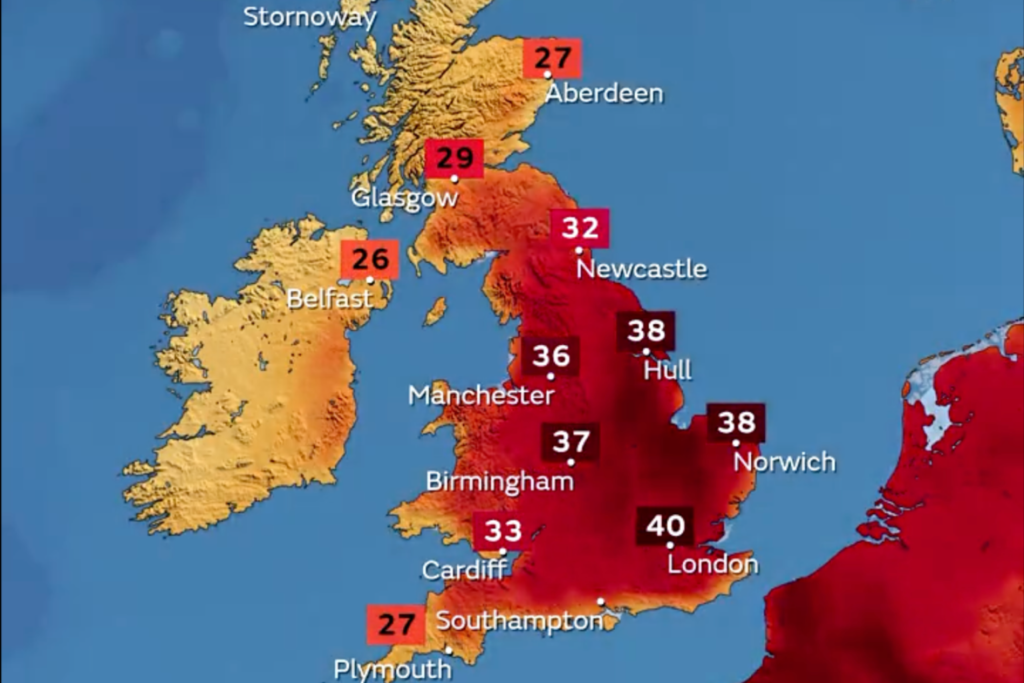
Temperatures across central and southern England and Wales are expected to peak at 38°C on Wednesday 24 and Thursday 25 June — with some spots potentially pushing even higher. The University of Reading has warned that temperatures in Reading could reach 40°C at their peak on Wednesday, which would obliterate the university’s own records. For context, the highest temperature ever recorded in the UK was 40.3°C, set at Coningsby in Lincolnshire on 19 July 2022.
The current UK record for June stands at 35.6°C, recorded in Southampton in 1976 and Camden Square in 1957. The Met Office says it is now expected that both of those long-standing records will be broken.
Why this heatwave is different
What sets this event apart from previous heatwaves — including the record-breaking one of July 2022 — is the combination of extreme heat with exceptionally high humidity. Dew points are forecast to reach around 22°C in places on Wednesday and Thursday. During the 2022 heatwave, humidity levels in Reading on the peak day were around 28% — this week’s conditions are expected to be significantly more oppressive.
Dr Akshay Deoras of the University of Reading described it as “a heat-dome driven furnace” rather than a standard heatwave. A heat dome is a vast area of high pressure parked over the UK and western Europe, trapping hot air and preventing it from dispersing.
The practical effect of the humidity is significant. High humidity prevents sweat from evaporating properly, which is how the body cools itself. Dr Jess Neumann, also of the University of Reading, noted that the critical threshold — known as a wet bulb temperature of 35°C — is the point at which even a healthy person at rest cannot cool themselves regardless of water intake or shade. While the UK is not expected to reach that level, the combination of heat and humidity will make conditions genuinely dangerous for a much wider group of people than usual.
Overnight temperatures
There will also be no meaningful respite overnight. Widespread Tropical Nights — where temperatures do not drop below 20°C — are forecast across much of England and Wales, especially in urban areas including London. The Met Office’s Deputy Chief Forecaster Mark Sidaway warned that consecutive tropical nights will prevent people from recovering from the daytime heat, significantly worsening the impact of heat stress.
Health warnings
The Red warning — the highest alert level the Met Office issues, reserved for situations with a risk to life — covers central and southern England and Wales from 9am on Wednesday to 9pm on Thursday. It was preceded by amber and yellow heat-health alerts from the UK Health Security Agency on 22 June.
The Met Office’s Chief Scientist, Professor Stephen Belcher CBE, said the heatwave will be “a significant weather event” and warned of “very high temperatures and humidity bringing significant health implications from heat stress, as well as impacts to a range of sectors such as transport, energy and water supply.”
The British Red Cross has urged people to recognise the symptoms of heat exhaustion and heatstroke, avoid activity during the hottest part of the day, wear sunscreen, drink plenty of water and reduce alcohol consumption. The RNLI has also reminded people that despite the air temperature, coastal and open water remains cold and carries serious risks if entered unexpectedly.
When will it end
High pressure is forecast to gradually shift eastward on Friday and through the weekend, which should ease temperatures slightly — though those in the southeast will retain exceptional warmth the longest. The northwest of England and Scotland will remain cooler and cloudier throughout, with more unsettled conditions returning there from Monday.
Climate context
Professor Belcher noted that human-induced climate change has made events like this both more likely and more intense. “To see temperatures like this in the UK in June is sobering,” he said. This is the second official heatwave of the year in the UK, following an earlier spell in May 2026. The frequency and intensity of heatwaves has increased worldwide, and the infrastructure and housing stock of a country like the UK — not built with extreme heat in mind — faces increasing strain as these events become more common.